
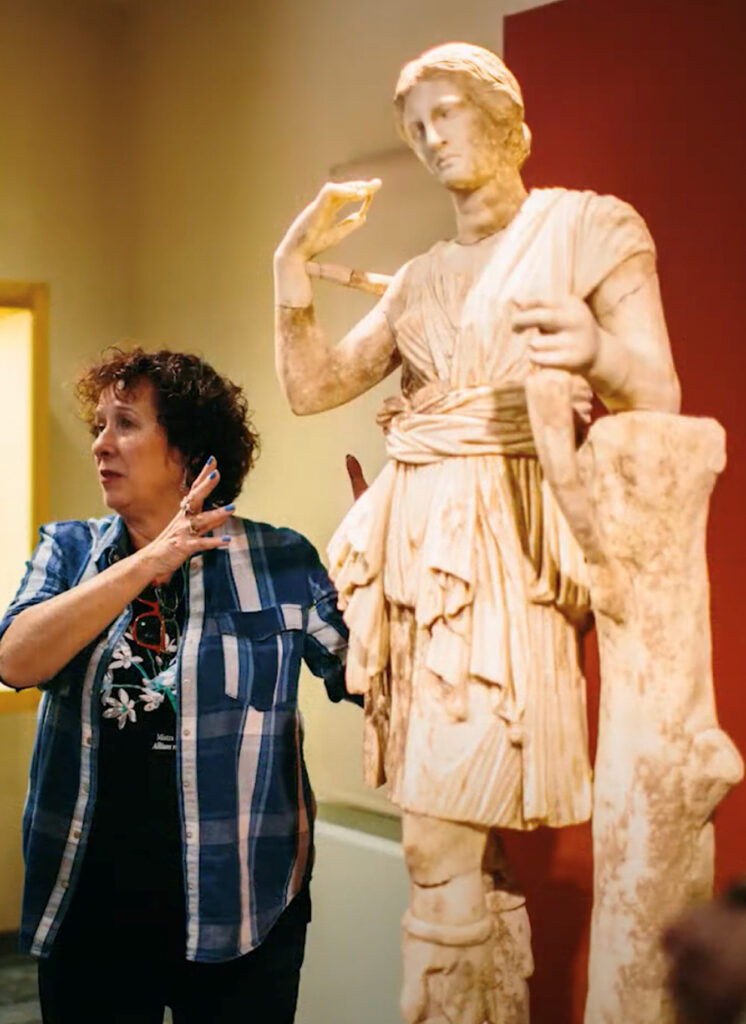
Expert-led tours can transform the experience of visiting a great garden, painting, battlefield or historic building.
Most of us have had that moment:
Standing in a great garden and knowing it’s important, but not quite knowing why. Looking at a painting that feels meaningful, but not yet readable. Or standing on a battlefield where something vast and consequential happened, sensing the weight of it — without fully being able to grasp what unfolded under your feet.
The place is real. The history is real. But there is still a gap between being there and understanding where you are.
Travelling with a true expert closes that gap.
Not through lecture or performance, but through something far more subtle: the way they shift your attention. The details they point out. The questions they ask. The connections that suddenly make a landscape, a painting, or a room click into place.
At Travel Editions, our tour leaders are not guides in the conventional sense. They are working specialists — published authors, curators, broadcasters, Fellows of learned societies — people who actively contribute to their fields today. What they bring is not just knowledge, but perspective shaped by decades of immersion.
And once you’ve travelled with them, it’s very hard to go back to seeing things the same way again.
Good gardens don’t just grow — they speak. Our experts know how to listen
Few people read gardens quite like David Hurrion.
Associate Editor of BBC Gardeners’ World Magazine, RHS Floral Judge, and member of the RHS Tender Plant Committee, David has spent more than 50 years working in gardens and nurseries across Britain. He has judged at Chelsea, designed show gardens, and spent a lifetime thinking about how plants behave — and what they reveal about the spaces they inhabit.
Walking a garden with David changes the experience completely.
Suddenly, you’re not just seeing colour and structure — you’re seeing intention. Why a planting scheme works with the light. Why a border has been shaped in a particular direction. What the soil, slope and shelter are quietly telling you about what can grow there.
It becomes less about recognition and more about understanding.
Guests often say they return home and start looking at their own gardens differently — not because they’ve been told what to think, but because they now notice more than they used to.
“I have been looking at plants my whole life and I still find that the moment you encounter something growing in its natural habitat, in the soil and light it evolved for, it makes complete sense in a way it never quite does anywhere else. That is what travelling to see gardens and plants does for me, and I hope it does for the people who come with me too.”
Alongside him, Tony Russell brings an entirely different but equally revealing perspective.
Former Head Forester at Westonbirt Arboretum for 14 years, author of more than 18 books — including The World Encyclopedia of Trees and Trees of Britain and Europe — Tony sees landscapes from the ground up. A regular on Gardeners’ Question Time and BBC Radio 4’s Inspiring Trees, he has also accompanied over 70 international garden tours across six continents.
With Tony, gardens stop being composed of separate elements and start to feel like systems — living, evolving structures shaped over time. Trees become anchors of memory. Planting becomes history. A landscape becomes something you read, not just walk through.
“Battlefields and castles and historic sites are not just places where things happened. They are places where decisions were made, often under extraordinary pressure, that changed the course of events for everyone who came after. When I stand on a battlefield with a group of people and we start to unpick what actually happened and why, I want them to feel the contingency of it, the fact that it could so easily have gone differently. That feeling, I think, is what history is really for.”
Art doesn’t just decorate space — it argues with it
Travelling with Dr Anne Anderson FSA is to discover that buildings and interiors are rarely just beautiful — they are deliberate.
Honorary Associate Professor at the University of Exeter, Fellow of the Society of Antiquaries, and lecturer for Christie’s and the Art Fund, Anne has spent over 30 years specialising in Art Nouveau architecture and design. She has curated major exhibitions, written extensively on decorative arts, and lectured internationally from Europe to Australasia.
In her company, Art Nouveau stops being ornamental and starts being expressive.
A façade is no longer simply decorative — it becomes a statement about modernity. A wrought-iron detail is not just craft, but ideology. A building becomes an argument in stone and glass about how the modern world should look and feel.
What once felt like decoration becomes language.
And once you understand that language, you can’t quite unsee it.
“What I love about the Arts and Crafts movement and Art Nouveau is that they were genuinely radical. These were people who believed that the things you surrounded yourself with every day, your furniture, your wallpaper, your ceramics, could either deaden or enrich your experience of being alive. That is not a historical curiosity. It is a question we still need to ask. When I take people to the houses and collections where these ideas were put into practice, I want them to feel the force of that argument, not just admire the beautiful objects.”
Battlefields are not empty spaces — they are decisions made visible
Few people make military history as immediate as Julian Humphrys.
A Cambridge history graduate, former curator at the National Army Museum, Fellow of the Royal Society of Arts, and Chair of the South-East Region of the Battlefields Trust, Julian has spent decades working with sites including Culloden, Waterloo and D-Day. He has written widely for BBC History Magazine, produced audio guides for major historic sites, and led battlefield tours across Europe.
His perspective is simple but transformative: battlefields are not “just fields”.
Standing at Bosworth or Waterloo with Julian, the landscape becomes legible. A ridge becomes a tactical advantage. A slope becomes a fatal constraint. Distances become timing. And suddenly, decisions made 500 years ago feel not abstract but immediate — shaped by terrain, pressure, and human judgement under extreme conditions.
It is history stripped of distance.
And it changes how you understand conflict entirely.
